





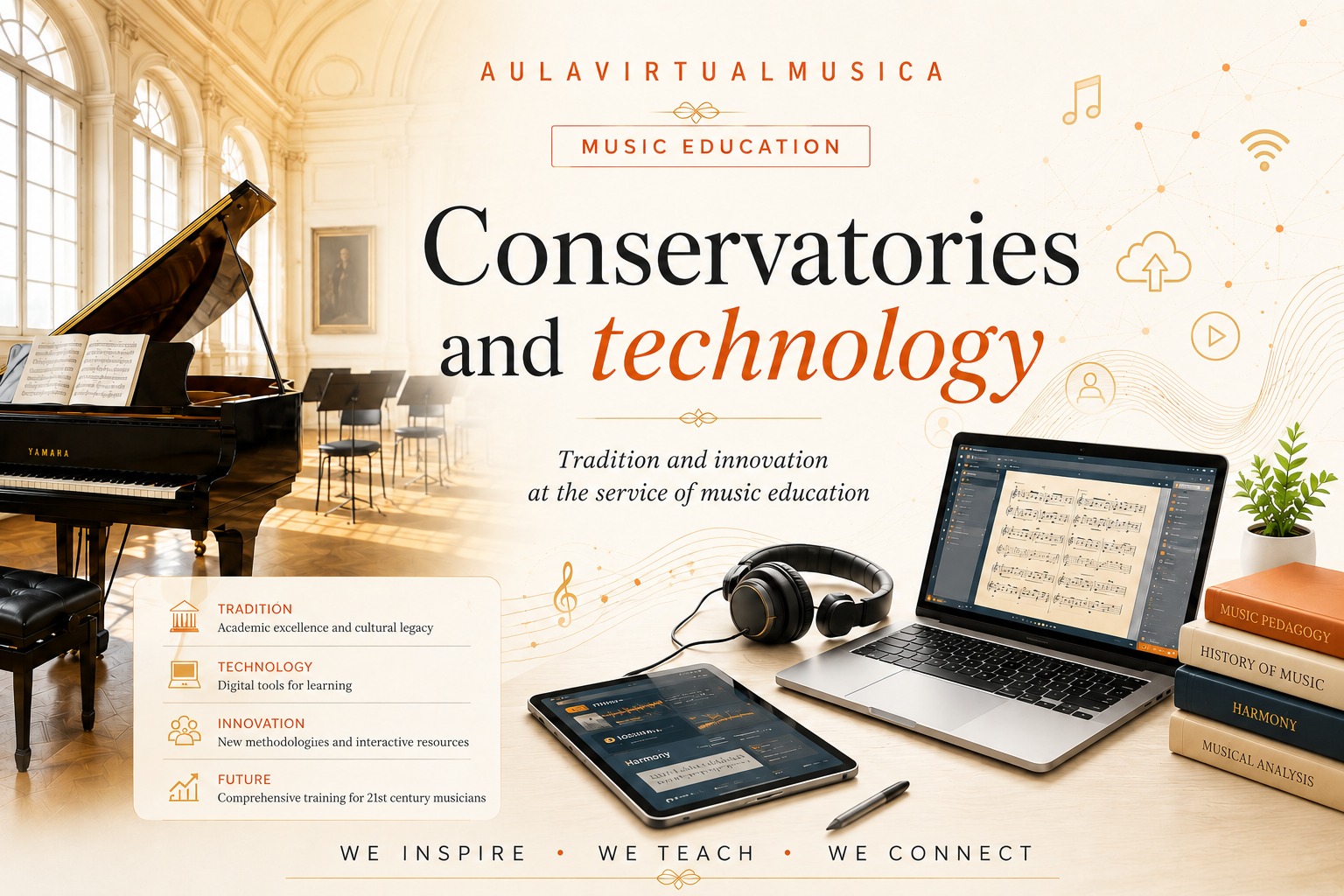
Imagine walking into a conservatoire thirty years ago. The grand piano in the classroom, the paper scores, the pendulum metronome on the music stand. The teacher listens, corrects, listens again. The student repeats. This has been the way for centuries. There is something beautiful in that image, but also something limited: the entire weight of learning rests on that weekly hour of class, and outside it, the student is alone.
That scene still exists, and it does not have to disappear. But around it, a completely new ecosystem has grown. The most advanced conservatoires and music schools have been integrating technology for years, not to replace tradition, but to expand it. So that learning does not begin and end in the classroom. So that every student, whatever their starting point, has access to tools that were once available only to a few.
Technology has not arrived in music education to replace the teacher. It has arrived so that the teacher can finally do everything they have always wanted to do.
A change that had been taking shape for years
The process did not happen all at once. It began slowly, almost silently: a teacher using notation software to prepare arrangements, a school installing an electronic keyboard classroom in order to work with large groups, a conservatoire recording auditions so that students could listen to themselves afterwards. Small steps which, taken together, gradually transformed the way music is taught and learned.
What accelerated that process was the arrival of interactive methodologies: platforms, applications and resources designed specifically for music education, placing the student at the centre of their own learning. It was no longer just a matter of digitising what had previously been on paper. It was about making possible things that, quite simply, could not be done before.
The most important changes, one by one
-
From paper-based solfège to interactive music reading
Interactive platforms have transformed the learning of music theory and musicianship. The student no longer just reads a score: they listen to it, follow it in real time, repeat it at their own pace and receive immediate correction. What once required the teacher’s presence for every exercise can now happen at home, on the bus, at any time. And when the student arrives in class, they arrive having truly practised. -
Composition is no longer exclusive territory
For a long time, composing in a conservatoire was something reserved for advanced courses, for those who had already mastered harmony and counterpoint. Digital tools have democratised that access. Today, an elementary-level student can create their own piece, listen to it straight away, modify it and share it. This profoundly changes their relationship with music: they are no longer only performers, they are also authors. -
The classroom without walls: learning beyond the timetable
One of the historic limitations of music education was class time, always scarce. Interactive platforms have extended that time naturally. The student practises at home with resources selected by their teacher, progresses at their own pace, and the teacher can monitor that progress without needing to be physically present. Face-to-face lessons gain in quality because they no longer have to cover everything from scratch. -
Musical listening, much richer and deeper
Listening to a work is no longer a passive act. Digital tools make it possible to view the score while it sounds, identify instruments, compare historical versions, slow down complex passages or isolate voices. For a student who is learning to listen with intention, that level of detail is transformative. What was once difficult to explain in words can now be shown in real time. -
Assessment becomes fairer and more useful
Recording performances, analysing tempo, detecting intonation problems with objective precision: technology has given teachers assessment tools that go beyond the subjective impression of the moment. And it gives students something very valuable in return: the ability to listen to themselves, to compare today’s performance with the one from three months ago, to hear with their own ears that they are making progress.
The distinction that education policies overlook
The debate about screens in primary education needs a distinction that is too often ignored in education policy documents: the difference between consumer use and creative use. Watching a YouTube video without purpose is passive consumption. Composing a piece, recording a performance or analysing a recording are cognitively active acts that no serious neuroscientist would consider equivalent.
The most rigorous recommendations —those of the Institute for Child Mind, those of Jean Twenge or those of the systematic review by Madigan et al. (2019)— are not aimed at active educational use mediated by teachers. They are aimed at recreational and unstructured screen time. Using those studies as support for removing digital tools from music lessons is an extrapolation that the authors themselves would reject.
Platforms such as aulavirtualmusica.com have been an active part of this transformation. With resources designed specifically for music education —ear-training activities, creative tasks, progress tracking— they have shown that well-applied technology does not distract from musical learning. It deepens it.
Music theory, from tollgate to discovery
In conservatoires, music theory and musicianship have always been compulsory, but rarely central. They were the invisible scaffolding: something studied because it was needed in order to play, not because anyone chose it for its own sake. The student arrived because of the violin, the piano, the guitar. Solfège came included in the package, almost like a toll.
What has changed with technology is not the structure —the conservatoire remains a conservatoire, with its official curriculum and compulsory instrument— but the experience of that subject. When music theory is worked on with interactive tools —listening, identifying, creating, responding in real time instead of filling in paper exercises— it stops feeling like an obstacle. Many students who arrived resigned to solfège suddenly discover that understanding music from within is something they are passionate about. And that shows: in their motivation, in the pace of learning, and in how that knowledge transfers directly to the instrument.
Beyond conservatoires, independent music schools —without the regulated structure of the official curriculum— have gone even further: they offer workshops in theory, musicianship and production for adults and teenagers who create music on a computer and need a conceptual framework, or who simply want to better understand what they hear. It is not the conservatoire model, but it meets a real and growing need. Two different models, each in its own field, responding together to the same reality: more and more people want to engage with music in a more conscious way.
And the most traditional ones? They are changing too
Perhaps the most significant change is the one taking place in the centres most reluctant to change. The conservatoires with the longest histories, those that kept their methods almost untouched for decades, are also incorporating technology, although they do so more cautiously and at their own pace. And that makes a great deal of sense: the performance tradition they preserve is a heritage that deserves care. What technology offers is not a break with that tradition, but new layers of support so that this tradition can reach more students, in greater depth and for longer.
The conservatoire of the future is not a room full of screens. It is a space where the musical rigour of always coexists with tools that expand what can be learned, practised and created. Where the student arriving at their piano lesson has already been able to listen to the piece twenty times, follow the score and work on the pulse independently. And where the teacher can devote that precious time to what no application can do: transmit a love of music.
That change is already happening. And those experiencing it from within, whether as teachers, students or families, know that there is no going back.
Would you like to discover how aulavirtualmusica.com supports this change in music schools and conservatoires?
Explore Aula Virtual Música