





AulaVirtual
  • Home
  • Music and Movement
  • Elementary
  • Professional
  • Primary
  • Blog
  • Apps
  • Contact
  • Idiomas (EN)

Select your language

  • Español (España)
  • Valencià
  • Catalan (ca-ES)
  • English (United Kingdom)
  • Basque (eu-ES)
AccesoLog in

BLOG


Subscribe to the blog

Get an email when we publish a new article.

For decades, music education barely changed. Then interactive technology arrived. And nothing was ever the same again.

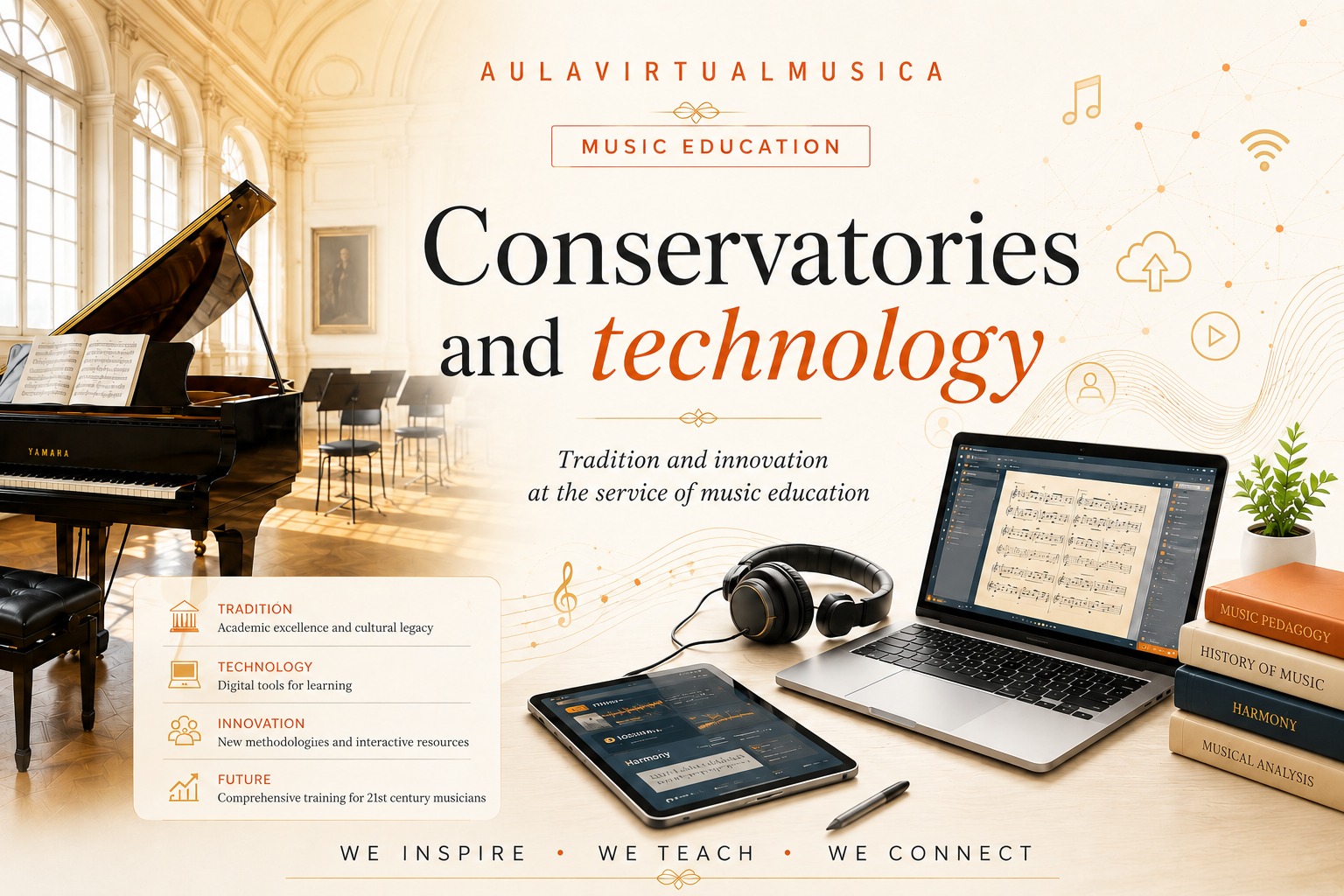
Conservatories and music schools: the technological leap that is already happening

Details
Category: Blog

Imagine walking into a conservatoire thirty years ago. The grand piano in the classroom, the paper scores, the pendulum metronome on the music stand. The teacher listens, corrects, listens again. The student repeats. This has been the way for centuries. There is something beautiful in that image, but also something limited: the entire weight of learning rests on that weekly hour of class, and outside it, the student is alone.

That scene still exists, and it does not have to disappear. But around it, a completely new ecosystem has grown. The most advanced conservatoires and music schools have been integrating technology for years, not to replace tradition, but to expand it. So that learning does not begin and end in the classroom. So that every student, whatever their starting point, has access to tools that were once available only to a few.

Technology has not arrived in music education to replace the teacher. It has arrived so that the teacher can finally do everything they have always wanted to do.

A change that had been taking shape for years

The process did not happen all at once. It began slowly, almost silently: a teacher using notation software to prepare arrangements, a school installing an electronic keyboard classroom in order to work with large groups, a conservatoire recording auditions so that students could listen to themselves afterwards. Small steps which, taken together, gradually transformed the way music is taught and learned.

What accelerated that process was the arrival of interactive methodologies: platforms, applications and resources designed specifically for music education, placing the student at the centre of their own learning. It was no longer just a matter of digitising what had previously been on paper. It was about making possible things that, quite simply, could not be done before.

The most important changes, one by one

  1. From paper-based solfège to interactive music reading
    Interactive platforms have transformed the learning of music theory and musicianship. The student no longer just reads a score: they listen to it, follow it in real time, repeat it at their own pace and receive immediate correction. What once required the teacher’s presence for every exercise can now happen at home, on the bus, at any time. And when the student arrives in class, they arrive having truly practised.

  2. Composition is no longer exclusive territory
    For a long time, composing in a conservatoire was something reserved for advanced courses, for those who had already mastered harmony and counterpoint. Digital tools have democratised that access. Today, an elementary-level student can create their own piece, listen to it straight away, modify it and share it. This profoundly changes their relationship with music: they are no longer only performers, they are also authors.

  3. The classroom without walls: learning beyond the timetable
    One of the historic limitations of music education was class time, always scarce. Interactive platforms have extended that time naturally. The student practises at home with resources selected by their teacher, progresses at their own pace, and the teacher can monitor that progress without needing to be physically present. Face-to-face lessons gain in quality because they no longer have to cover everything from scratch.

  4. Musical listening, much richer and deeper
    Listening to a work is no longer a passive act. Digital tools make it possible to view the score while it sounds, identify instruments, compare historical versions, slow down complex passages or isolate voices. For a student who is learning to listen with intention, that level of detail is transformative. What was once difficult to explain in words can now be shown in real time.

  5. Assessment becomes fairer and more useful
    Recording performances, analysing tempo, detecting intonation problems with objective precision: technology has given teachers assessment tools that go beyond the subjective impression of the moment. And it gives students something very valuable in return: the ability to listen to themselves, to compare today’s performance with the one from three months ago, to hear with their own ears that they are making progress.

The distinction that education policies overlook

The debate about screens in primary education needs a distinction that is too often ignored in education policy documents: the difference between consumer use and creative use. Watching a YouTube video without purpose is passive consumption. Composing a piece, recording a performance or analysing a recording are cognitively active acts that no serious neuroscientist would consider equivalent.

The most rigorous recommendations —those of the Institute for Child Mind, those of Jean Twenge or those of the systematic review by Madigan et al. (2019)— are not aimed at active educational use mediated by teachers. They are aimed at recreational and unstructured screen time. Using those studies as support for removing digital tools from music lessons is an extrapolation that the authors themselves would reject.

The role of interactive methodologies:

Platforms such as aulavirtualmusica.com have been an active part of this transformation. With resources designed specifically for music education —ear-training activities, creative tasks, progress tracking— they have shown that well-applied technology does not distract from musical learning. It deepens it.

Music theory, from tollgate to discovery

In conservatoires, music theory and musicianship have always been compulsory, but rarely central. They were the invisible scaffolding: something studied because it was needed in order to play, not because anyone chose it for its own sake. The student arrived because of the violin, the piano, the guitar. Solfège came included in the package, almost like a toll.

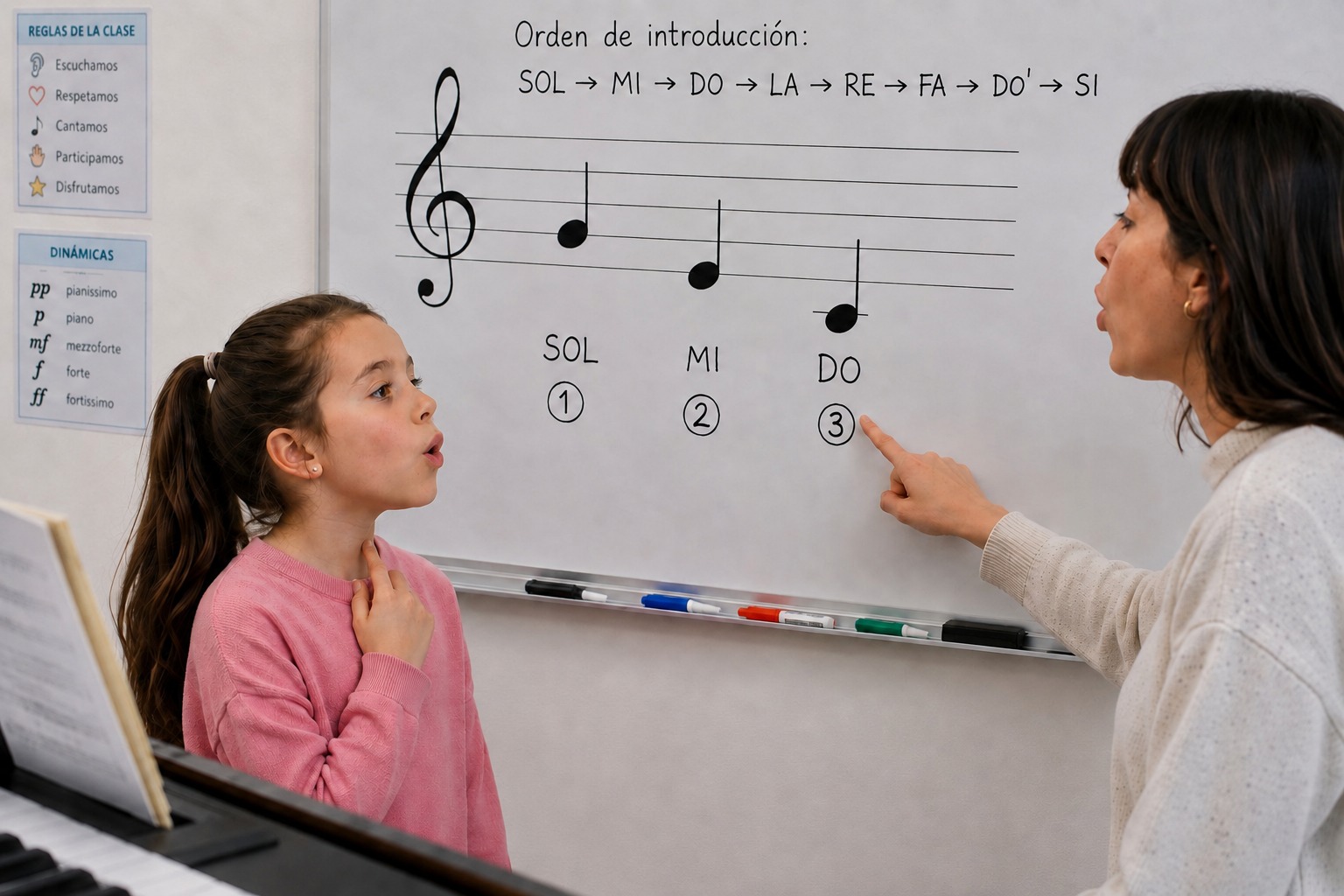
What has changed with technology is not the structure —the conservatoire remains a conservatoire, with its official curriculum and compulsory instrument— but the experience of that subject. When music theory is worked on with interactive tools —listening, identifying, creating, responding in real time instead of filling in paper exercises— it stops feeling like an obstacle. Many students who arrived resigned to solfège suddenly discover that understanding music from within is something they are passionate about. And that shows: in their motivation, in the pace of learning, and in how that knowledge transfers directly to the instrument.

Beyond conservatoires, independent music schools —without the regulated structure of the official curriculum— have gone even further: they offer workshops in theory, musicianship and production for adults and teenagers who create music on a computer and need a conceptual framework, or who simply want to better understand what they hear. It is not the conservatoire model, but it meets a real and growing need. Two different models, each in its own field, responding together to the same reality: more and more people want to engage with music in a more conscious way.

And the most traditional ones? They are changing too

Perhaps the most significant change is the one taking place in the centres most reluctant to change. The conservatoires with the longest histories, those that kept their methods almost untouched for decades, are also incorporating technology, although they do so more cautiously and at their own pace. And that makes a great deal of sense: the performance tradition they preserve is a heritage that deserves care. What technology offers is not a break with that tradition, but new layers of support so that this tradition can reach more students, in greater depth and for longer.

The conservatoire of the future is not a room full of screens. It is a space where the musical rigour of always coexists with tools that expand what can be learned, practised and created. Where the student arriving at their piano lesson has already been able to listen to the piece twenty times, follow the score and work on the pulse independently. And where the teacher can devote that precious time to what no application can do: transmit a love of music.

That change is already happening. And those experiencing it from within, whether as teachers, students or families, know that there is no going back.

Would you like to discover how aulavirtualmusica.com supports this change in music schools and conservatoires?

Explore Aula Virtual Música
Ver más +
When efforts to reduce digital devices in primary schools clash with the very subject that should inspire a lifelong love of music.

Screens in Music Class: Problem or Opportunity?

Details
Category: Blog

In recent years, educational bodies in several countries —and some regional authorities in Spain— have issued recommendations aimed at reducing or eliminating the use of digital devices in primary school classrooms. The central argument appeals to evidence on the impact of screens on attention, handwriting and early cognitive development. That evidence exists, it is solid in certain contexts, and it deserves to be taken seriously. However, applying it indiscriminately to every subject and every activity is a category error: it confuses the medium with the message, and pays the highest price in one of the most distinctive subjects in the curriculum: music.

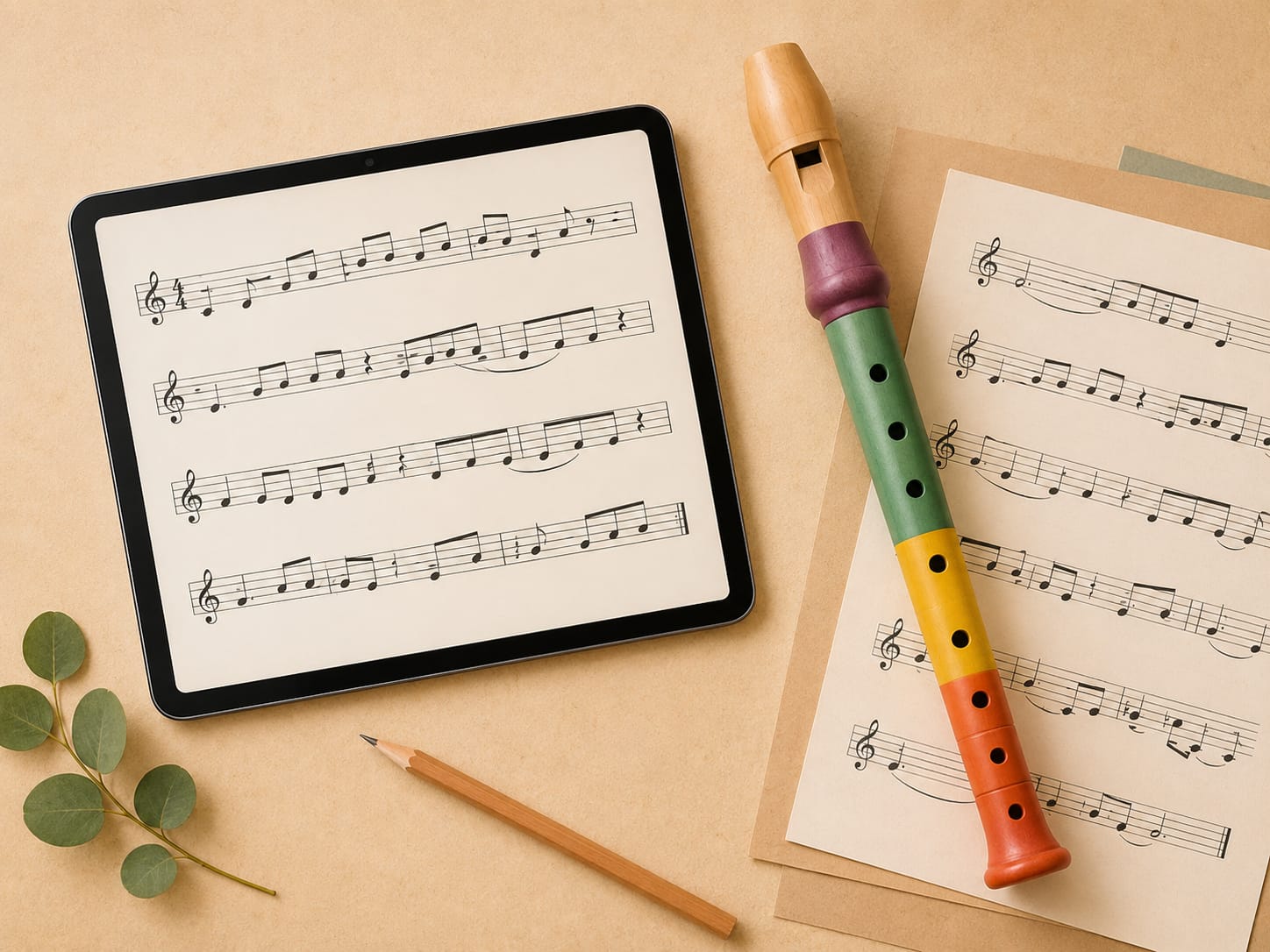
Music education in primary school is not a “content-based” subject in the conventional sense of the term. It is not mainly about reading text, taking notes or solving algorithmic problems. It is a discipline of active listening, sound creation, body expression and non-verbal language. And today’s digital ecosystem offers tools for accessing sound, composition and musical practice that have no viable analogue equivalent in a classroom of twenty pupils with a single teacher.

The screen argument does not hold up when applied to music

The research supporting digital restrictions focuses almost exclusively on the use of screens for passive content consumption —social media, video without a pedagogical purpose— or on the replacement of handwriting in language and mathematics subjects. These contexts are radically different from using a tablet to read interactive scores, record an improvised melody or explore the timbre of instruments from distant cultures.

Reducing every digital interaction to the same archetype —the screen as a passive and distracting element— is a generalisation that the very researchers behind these policies would not make. The variable that matters is not whether there is a screen or not: it is what the pupil does with it and under what kind of teacher mediation.

Banning the device in music does not protect children from excessive screen use. It only deprives them of the most powerful tool currently available for making music in the classroom.

Six reasons why music in primary school needs the digital world

  1. Democratic access to sound
    Not all schools have enough instruments. A tablet with the right application puts a keyboard, a drum kit or a percussion set into the hands of every pupil —resources the school could never afford in physical format. Restricting devices, in these cases, means widening the instrumental gap between schools.

  2. Comparative and intelligent listening
    Aural analysis —identifying instruments, musical forms and rhythmic patterns— is greatly enriched when pupils can access multiple versions of the same work, slow down fragments, isolate tracks or visualise the waveform. No CD player offers that capability.

  3. Composition and creativity from an early age
    Intuitive composition apps allow an eight-year-old child to create a layered musical piece, structure a melody over an ostinato or experiment with harmony without needing to master conventional notation. This is exactly what the LOMLOE curriculum calls for in the area of musical creation.

  4. Cultural diversity within reach of the classroom
    The study of music from around the world —an explicit objective of current music education— is unmanageable without access to recordings, virtual instruments and audiovisual resources. Without a device, the Japanese koto, the Zimbabwean mbira or the Galician bagpipe are merely names in a textbook.

  5. Immediate feedback in instrumental learning
    Pitch- or rhythm-recognition applications offer pupils objective feedback that a teacher, while attending to twenty pupils simultaneously, physically cannot provide with the same frequency and precision. This does not replace the teacher; it frees them for higher-value pedagogical intervention.

  6. Motivation and connection with pupils’ musical culture
    Children today experience music through digital platforms. Ignoring this does not make them better musicians; it turns them into pupils who feel that school music has nothing to do with real music. Building bridges between both realities is a pedagogical responsibility, not a concession to leisure.

The distinction educational policies overlook

The debate on screens in primary education needs a distinction that is too often overlooked in educational policy documents: the difference between consumer use and creative use. Watching a YouTube video without purpose is passive consumption. Composing a piece, recording a performance or analysing a recording are cognitively active acts that no serious neuroscientist would consider equivalent.

The most rigorous recommendations —those of the Child Mind Institute, those of Jean Twenge, or those of the systematic review by Madigan et al. (2019)— do not target active educational use mediated by teachers. They target recreational and unstructured screen time. Using those studies as support for removing digital tools from music class is an extrapolation that the authors themselves would reject.

Digital tools for music in primary school

Platforms such as aulavirtualmusica.com offer primary school teachers resources specifically designed for the classroom: from aural education activities to interactive musical creation proposals, with pedagogical mediation built into the resource itself.

These kinds of tools are not screens for the sake of screens: they are the digital equivalent of the manuscript notebook, the metronome and the classroom piano, all in one, accessible from any device and adapted to the current curriculum.

A proposal for school leadership teams

Concern for pupils’ digital wellbeing is legitimate and should translate into clear protocols. But those protocols must be intelligent; that is, they must distinguish by subject, by type of activity and by mode of use. A well-designed device policy can perfectly restrict free screen use during break time and in subjects where the evidence against them is stronger, while at the same time guaranteeing access to digital tools in music when the activity requires it.

What good educational policy cannot do is ignore that subjects are not interchangeable, that contexts of use matter, and that depriving music education of its most powerful tools in the name of a well-intentioned but uncritical uniformity ultimately impoverishes the musical experience of an entire generation of children.

Music teachers have been integrating technology with rigour and pedagogical purpose for years. We need educational policies to support us in that direction, not to place obstacles in our way. The debate is not screens yes or screens no. The debate is when, how and for what purpose. And in music, the answer to that “for what purpose” is often extraordinarily powerful.

Do you share this reflection? Pass it on to your school leadership team and open the debate.

Explore AulaVirtualMusica
 

References mentioned:

  • Madigan, S. et al. (2019). «Association Between Screen Time and Children's Performance on a Developmental Screening Test». JAMA Pediatrics, 173(3), 244–250.
  • Twenge, J. M. & Campbell, W. K. (2018). «Associations between screen time and lower psychological well-being among children and adolescents». Preventive Medicine Reports, 12, 271–283.
  • LOMLOE – Organic Law 3/2020. Royal Decree 157/2022 establishing the organisation and minimum teaching requirements for Primary Education.
Ver más +
Contactar
AulaVirtual
  • Legal Notice and Data Protection
  • Security Policy
  • Terms and Conditions
  • Buyer Safety
  • Code of Ethics