






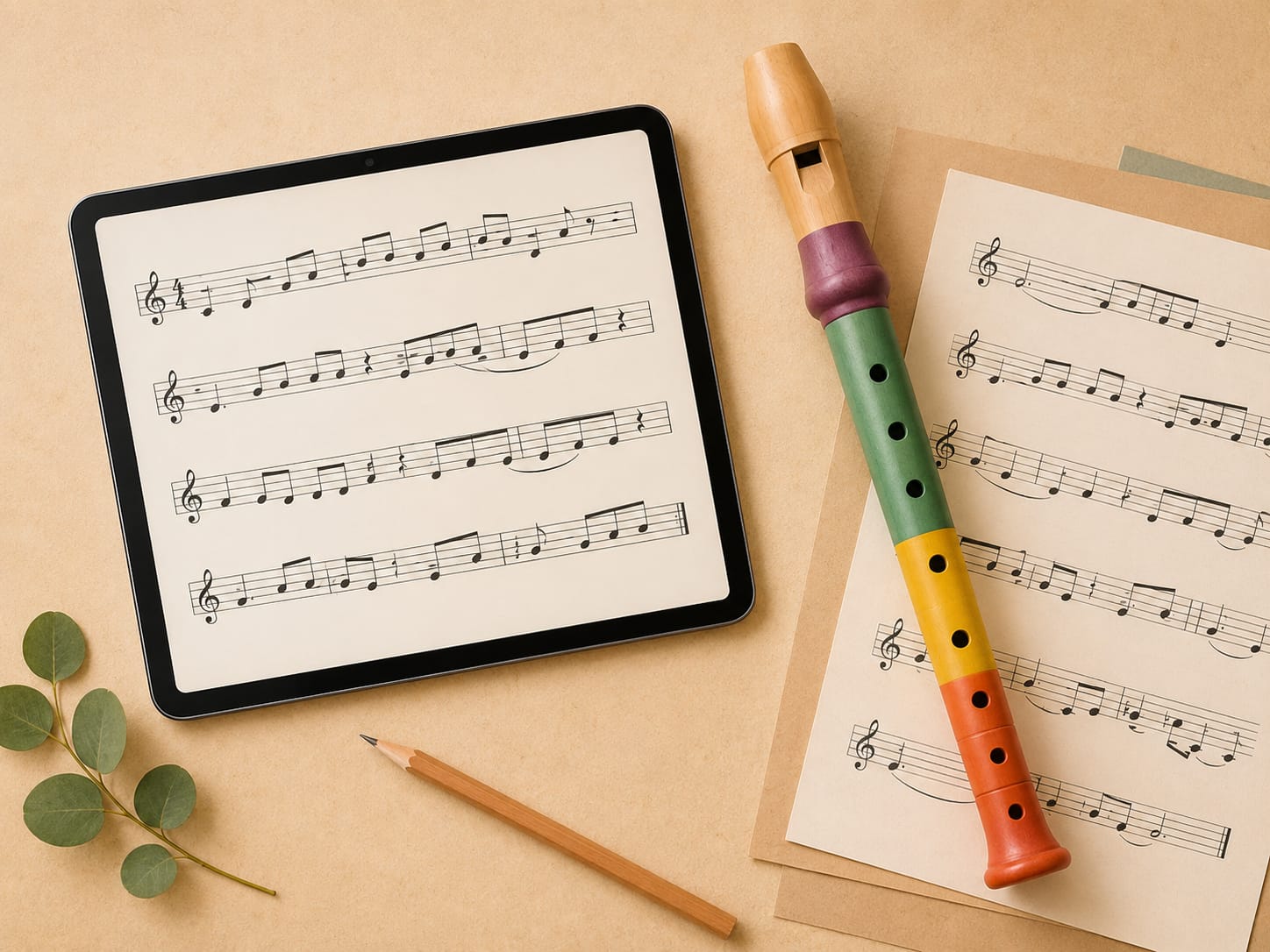
In recent years, educational bodies in several countries —and some regional authorities in Spain— have issued recommendations aimed at reducing or eliminating the use of digital devices in primary school classrooms. The central argument appeals to evidence on the impact of screens on attention, handwriting and early cognitive development. That evidence exists, it is solid in certain contexts, and it deserves to be taken seriously. However, applying it indiscriminately to every subject and every activity is a category error: it confuses the medium with the message, and pays the highest price in one of the most distinctive subjects in the curriculum: music.
Music education in primary school is not a “content-based” subject in the conventional sense of the term. It is not mainly about reading text, taking notes or solving algorithmic problems. It is a discipline of active listening, sound creation, body expression and non-verbal language. And today’s digital ecosystem offers tools for accessing sound, composition and musical practice that have no viable analogue equivalent in a classroom of twenty pupils with a single teacher.
The screen argument does not hold up when applied to music
The research supporting digital restrictions focuses almost exclusively on the use of screens for passive content consumption —social media, video without a pedagogical purpose— or on the replacement of handwriting in language and mathematics subjects. These contexts are radically different from using a tablet to read interactive scores, record an improvised melody or explore the timbre of instruments from distant cultures.
Reducing every digital interaction to the same archetype —the screen as a passive and distracting element— is a generalisation that the very researchers behind these policies would not make. The variable that matters is not whether there is a screen or not: it is what the pupil does with it and under what kind of teacher mediation.
Banning the device in music does not protect children from excessive screen use. It only deprives them of the most powerful tool currently available for making music in the classroom.
Six reasons why music in primary school needs the digital world
-
Democratic access to sound
Not all schools have enough instruments. A tablet with the right application puts a keyboard, a drum kit or a percussion set into the hands of every pupil —resources the school could never afford in physical format. Restricting devices, in these cases, means widening the instrumental gap between schools. -
Comparative and intelligent listening
Aural analysis —identifying instruments, musical forms and rhythmic patterns— is greatly enriched when pupils can access multiple versions of the same work, slow down fragments, isolate tracks or visualise the waveform. No CD player offers that capability. -
Composition and creativity from an early age
Intuitive composition apps allow an eight-year-old child to create a layered musical piece, structure a melody over an ostinato or experiment with harmony without needing to master conventional notation. This is exactly what the LOMLOE curriculum calls for in the area of musical creation. -
Cultural diversity within reach of the classroom
The study of music from around the world —an explicit objective of current music education— is unmanageable without access to recordings, virtual instruments and audiovisual resources. Without a device, the Japanese koto, the Zimbabwean mbira or the Galician bagpipe are merely names in a textbook. -
Immediate feedback in instrumental learning
Pitch- or rhythm-recognition applications offer pupils objective feedback that a teacher, while attending to twenty pupils simultaneously, physically cannot provide with the same frequency and precision. This does not replace the teacher; it frees them for higher-value pedagogical intervention. -
Motivation and connection with pupils’ musical culture
Children today experience music through digital platforms. Ignoring this does not make them better musicians; it turns them into pupils who feel that school music has nothing to do with real music. Building bridges between both realities is a pedagogical responsibility, not a concession to leisure.
The distinction educational policies overlook
The debate on screens in primary education needs a distinction that is too often overlooked in educational policy documents: the difference between consumer use and creative use. Watching a YouTube video without purpose is passive consumption. Composing a piece, recording a performance or analysing a recording are cognitively active acts that no serious neuroscientist would consider equivalent.
The most rigorous recommendations —those of the Child Mind Institute, those of Jean Twenge, or those of the systematic review by Madigan et al. (2019)— do not target active educational use mediated by teachers. They target recreational and unstructured screen time. Using those studies as support for removing digital tools from music class is an extrapolation that the authors themselves would reject.
Platforms such as aulavirtualmusica.com offer primary school teachers resources specifically designed for the classroom: from aural education activities to interactive musical creation proposals, with pedagogical mediation built into the resource itself.
These kinds of tools are not screens for the sake of screens: they are the digital equivalent of the manuscript notebook, the metronome and the classroom piano, all in one, accessible from any device and adapted to the current curriculum.
A proposal for school leadership teams
Concern for pupils’ digital wellbeing is legitimate and should translate into clear protocols. But those protocols must be intelligent; that is, they must distinguish by subject, by type of activity and by mode of use. A well-designed device policy can perfectly restrict free screen use during break time and in subjects where the evidence against them is stronger, while at the same time guaranteeing access to digital tools in music when the activity requires it.
What good educational policy cannot do is ignore that subjects are not interchangeable, that contexts of use matter, and that depriving music education of its most powerful tools in the name of a well-intentioned but uncritical uniformity ultimately impoverishes the musical experience of an entire generation of children.
Music teachers have been integrating technology with rigour and pedagogical purpose for years. We need educational policies to support us in that direction, not to place obstacles in our way. The debate is not screens yes or screens no. The debate is when, how and for what purpose. And in music, the answer to that “for what purpose” is often extraordinarily powerful.
Do you share this reflection? Pass it on to your school leadership team and open the debate.
Explore AulaVirtualMusicaReferences mentioned:
- Madigan, S. et al. (2019). «Association Between Screen Time and Children's Performance on a Developmental Screening Test». JAMA Pediatrics, 173(3), 244–250.
- Twenge, J. M. & Campbell, W. K. (2018). «Associations between screen time and lower psychological well-being among children and adolescents». Preventive Medicine Reports, 12, 271–283.
- LOMLOE – Organic Law 3/2020. Royal Decree 157/2022 establishing the organisation and minimum teaching requirements for Primary Education.